

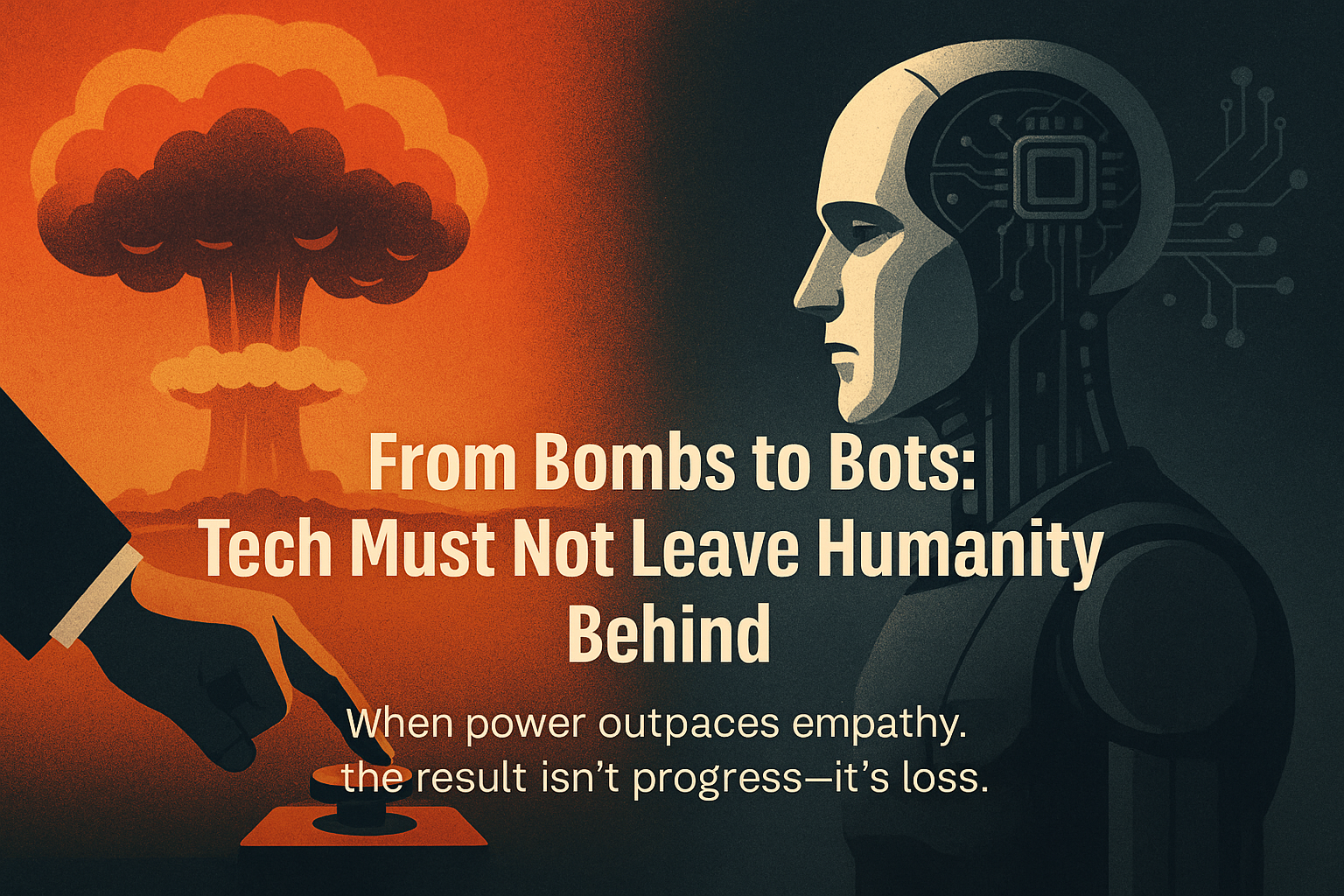
In the rush to adopt transformative technologies, organizations often focus on regulations, capabilities, and efficiencies. But there’s an uncomfortable silence around the most immediate casualty—people. Specifically, people whose jobs are rendered obsolete overnight, with little to no structural support for what comes next.
Let me step back and say this not as an outsider, but as someone who has lived inside this machinery. My last role was that of an Optimization Manager at a major bank in the financial sector. Before that, across different organizations and operational roles, I witnessed first-hand the relentless pursuit of efficiency—sometimes at the cost of people.
Back then, we thought we were streamlining, not destroying. The tools we implemented might have pushed a few people toward early retirement or restructuring, yes—but they didn’t wipe out entire departments. AI changes that equation. It doesn’t just make processes leaner—it replaces humans at scale.
And yet, even now, the most common, almost flippant, solution proposed is: “They just need to upskill.”
Let’s talk about that.
Reskilling isn’t opening a snack packet. It’s not just a motivational quote away. The average human lifespan today is around 70 years. The first 20 are spent in education and early development—learning, experimenting, building foundational skills. The final 15 to 20 years are often spent in retirement, living off what was earned and saved during working life. That leaves just 30 to 35 years of truly productive, income-generating time. These are the core years—where people work, raise families, pay loans, contribute to society, and try to carve out some security for the future.
And yet, when technology wipes out a job at 40 or 45, the world expects you to just “upskill” and leap into a more future-proof role. It looks tidy on a slide deck. But in real life? It’s brutal.
It’s hard—logistically, financially, emotionally. Not everyone learns at the same pace. People have different IQs, different interests, and vastly different life circumstances. Some struggle with digital tools. Some never had access to quality education in the first place. And most of us, let’s be honest, aren’t wired to start from scratch every decade.
In the corporate world, especially in tech-adjacent sectors, we sometimes (arrogantly and stupidly) brand such individuals as lazy or “not good enough.” That is not just unfair—it’s inhumane. I often challenge those who say, “Why can’t you just upgrade your skills?” and ask them to try doing that at 70. Sure, 40 and 70 aren’t the same—but the analogy holds. We are not machines. We are people. And we don’t all reboot on command.
So, what’s the answer?
It’s time for organizations to think beyond legal compliance and step into the realm of moral governance. If a tech implementation is likely to displace hundreds or thousands, a ring-fence must be created. Financial cushions. Guided transitions. Re-employment pathways. Mental health support. Not as charity—but as corporate responsibility.
Because if progress benefits only a few, while destabilizing the many. Can we really call it progress?
This conversation reminds me of something far more terrifying but rooted in the same logic: the nuclear weapon. Can a nuclear bomb end a war that drags on—sometimes for years, sometimes for decades? Yes. In minutes.
But will it solve the problem?
That’s the question every nation with nuclear power has had to confront. And time and again, the answer has been: Don’t press the button.
Because while a nuclear strike might “do the job,” it doesn’t end the suffering. It doesn’t rebuild what was lost. It leaves behind radioactive silence. Just because you can doesn’t mean you should.
The same principle applies to AI and automation. The power is real. The speed is staggering. But the consequences, if left unchecked it can be catastrophic.
Human-centered governance isn’t a luxury. It’s a necessity.
Because in the end, whether we’re holding a nuclear code or a line of code, our responsibility remains the same:
To make life better—not harder—for people.
“Intent Over Elegance” – A bad footwork isn’t always a problem as long as it’s backed by right intent and determination…
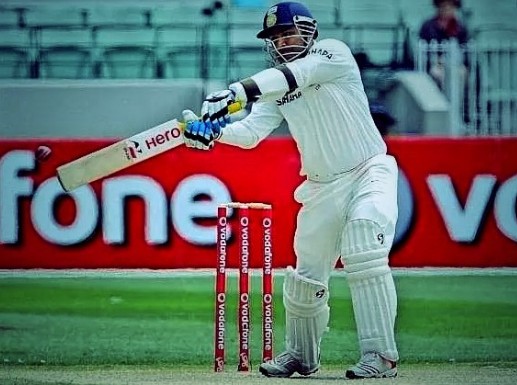 On this day—April 1st—let’s rewind to 1999. An uncanny, fearless cricketer from Delhi made his ODI debut for India. Cricket experts back then smirked, “His footwork is all wrong. He won’t survive international cricket.” Well… they were wrong. Spectacularly wrong.
That man went on to become one of the most explosive sportsmen and entertaining personalities world cricket has ever seen.
Fearless. Unapologetic. Natural.
He wasn’t just scoring runs—he was rewriting the rulebook.
He hit sixes with one run to go for a century…
He laughed in the face of pressure…
He tuned out the naysayers and only listened to the voices that mattered—legends like Sourav, Sachin, Dravid, Laxman, and Gautam.
He knew the difference between criticism and critics.
And yes, he famously whistled and sang through tense dressing room moments.
Because humor isn’t weakness—it’s strength in disguise.
I could go on from dawn to dusk about his records, his mindset, his greatness…
But let’s just say—he was, is, and will always be the “Nawab of Najafgarh”, “Sultan of Multan”, the one and only Virender Sehwag—our very own Viru.
And today—another debut.
This one, much closer to home. My daughter, my sweetheart, my #Yahvibaby, begins her formal schooling journey.
With a promise that she will never be burdened by the system…
That she won’t be forced to blindly follow the book…
That she’ll choose her path, and lead it with courage, curiosity, and a smile.
Just like Sehwag did—with confidence, joy, and that unmistakable sparkle in his eye.
I wish her all the success, and I look forward to the blessings and love of all our dear Happiness Club friends for her new beginning.
The Tariff Mindset — From Politics to Personal Life, Hurting Allies Hurts You
In politics or personal life, taming people who wish you well is the fastest way to lose what they bring to your world.
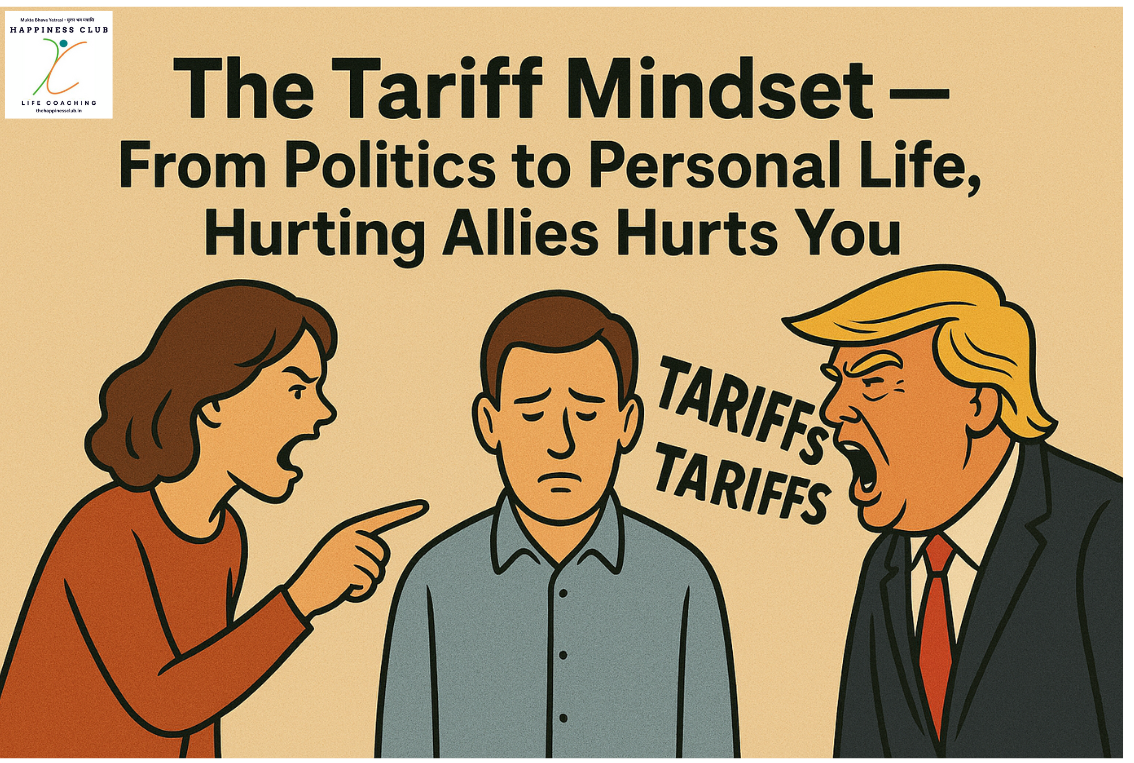
When President Trump decided to impose tariffs on friendly nations, the stated goal might have been to strengthen America’s position. But the execution — twisting the arms of allies — misses the point. You don’t secure loyalty by hurting those who already support you. You end up cutting off the flow of goodwill, trade, and trust that made the relationship valuable in the first place.
And even if the idea was to force more manufacturing back to the U.S., the reality isn’t that simple. Labor in America today is far more expensive than it was 40–50 years ago, when much of manufacturing first shifted overseas. The comfortable standard of living most Americans enjoy depends on the low prices made possible by overseas production — where, let’s be honest, many health, safety, and environmental rules are either relaxed or outright ignored. A T-shirt or an auto part made in India, Bangladesh, or Pakistan is cheaper partly because no American community would accept the environmental hazards or unsafe working conditions that come with such industries.
Beyond that, manufacturing ecosystems aren’t built overnight. An auto ancillary network takes 20–30 years to develop. Skills, suppliers, and cost efficiencies evolve over decades. You can’t just flip a switch and replace that with local production. To make it happen quickly, you’d likely need to import cheap labor — and that brings its own set of social and political challenges.
The same pattern often plays out in personal life. There are times when a person’s success benefits not just themselves but a whole network around them. Friends, relatives, and colleagues may enjoy the ripple effects — financial help, healthcare support, gifts, presence at important occasions, and the social prestige that comes with being connected to someone doing well.
But occasionally, a few people decide that this person needs to be “tamed.” They might play politics, undermine them, or try to exert control. They may believe that if this person’s career is disrupted, they can simply replace what was lost. But careers, like manufacturing ecosystems, take years to build. They require a unique mix of skills, experience, networks, and reputation. You can’t simply create that from scratch. And if you try, you may end up scrambling for replacements, only to discover you’ve traded a valuable resource for a hollow substitute.
It’s like cutting down the very tree that gives you shade, only to find yourself standing exposed under the harsh sun. Or shutting off the well because you wanted to “own” the water, only to discover the whole village is now thirsty. Or clipping the wings of a bird just to keep it in sight — and then wondering why it never sings again.
The irony? Those who tried to control often end up struggling to replace what they lost. They now buy for themselves what was once gifted freely, but they can’t purchase goodwill, ease, or the quiet pride that came from having such a person in their corner.
Whether in politics or personal life, when you harm those who bring value to you just to assert control, you don’t gain power — you lose allies. And eventually, you may find that your own “tariffs” cost you far more than they ever could have given.
The Flavor of Faith: How Secularism Tastes in Everyday India.
Forget the high-powered debates and the 24/7 news cycle. If you ask me what Indian secularism truly means, I’ll tell you it’s less about a dry, legal preamble and more about the messy, delicious truth of daily life. It’s not a grand political theory; it’s a social contract signed over chai and shared street food.
 The Problem of the Plate: Hygiene vs. Hatred
To understand the common man’s secularism, you have to understand the Indian kitchen. Like many families, we grew up with certain cultural habits around food — specifically the idea of jootha in Hindi or etho in Bangla: food touched by someone else’s mouth. For years, I simply didn’t eat from another person’s plate — whether it was a senior family member, a cousin, or a colleague. It’s a blend of cultural courtesy and, frankly, basic hygiene.
But a simple habit becomes a political statement the moment someone decides to judge it.
At a recent family wedding, a senior relative — lovely and strongly left-leaning — tried placing a half-eaten snack on my plate. When I politely refused, she instantly fired the accusation: “Oh, you won’t eat that because of your dharma and caste rules, right?”
I was stunned. I avoid it for the same reason I won’t share a water bottle with a stranger — it’s just health awareness. Yet she preferred the convenient narrative of casteism.
That’s the real tension of everyday secularism: Are we practicing culture, or are we being accused of propagating hate?
The Sacred Thread and the Logical Leaf
This ideological shaming survives because, for a certain section of society, anything rooted in Hindu practice is automatically branded backward or hateful. It’s a lazy reflex, not an informed view.
Take the simplest rituals. I wear a sacred thread. My Guru — a respected elder in the family — taught me disciplines around purity, conduct, and eating habits. I never saw any of it as superstition. For me, it’s structure. It’s hygiene. It’s just a way of bringing some order into daily life.
What some mock as a “purity obsession,” I see as discipline and plain health awareness.
And these practices aren’t blind dogmas. Look closer at the things often called “backward”:
- The Morning Offering: A banana and a Tulsi leaf as prasadam. Banana is potassium and fibre; Tulsi is medicinal. It’s a ritualised, healthy start.
- Charnamrit: A mix of milk, curd, ghee, honey, and sugar — essentially a probiotic blend long before “gut health” became fashionable.
- Evening Dhoop: Burning cow dung or coconut husk with neem and camphor is a natural mosquito and insect repellent, not just a devotional scent.
My secularism says: When a practice has inherent logic that benefits health or community, it deserves respect, not ridicule.
The Cook and the Courtesy
My relative didn’t stop at the plate. She pointed out that the food was being prepared by Muslim caterers, expecting a reaction. I just shrugged: “Their religion isn’t my concern. Hygiene is — and that’s the caterer’s job, regardless of faith.”
This is where I feel the secularism preached by the “pseudo-liberals” becomes narrow and one-sided. They expect me to abandon my culture in the name of openness, but conveniently ignore extremes in other communities, calling that ‘tolerance.’
My secularism is simple, practical, and mutual:
- I respect your boundary: If a Muslim friend is dining with me, I ensure there’s no pork.
- I expect respect for mine: I tell them upfront, “I don’t eat beef — just keep that in mind.”
This isn’t hatred; it’s courtesy. It’s the harmless creation of social boundaries that keeps the peace.
An Invisible Constitution
India runs not just on the Constitution, but on an invisible constitution — the moral and cultural code shaped by generations of practice and respect. This invisible code is what prevents unnecessary offence, and also what allows me to ask for my own space without being branded a bigot. Like air, I cannot see God or my ancestors, yet logic tells me they existed. Similarly, I rely on the wisdom embedded in our culture to live a disciplined, considerate life. My secularism isn’t anti-religion. It is about choosing what is open-minded, respectful, and logical. It is about a shared plate based on trust and courtesy — not political insecurity.
And that, to me, is a secularism that tastes sweet, not bitter.